

The Invisible Web: Why Fascia Healing is the Missing Link to Chronic Pain
You are a masterpiece of connection. When we understand this, we realize that pain isn’t a defect, it is simply a signal from a unified network waiting to return to balance. Your energy is meant to glide effortlessly, transforming stagnation into vitality. This isn’t just anatomy; it is a living history of how your body protects, adapts, and ultimately heals itself.
For years, we have been taught to look at pain in isolation. If your back hurts, treat the back. If your neck is stiff, rub the neck. But what if the pain you feel today isn’t just a local injury, but a systemic pattern? What if the “tightness” in your shoulders is actually a physical history of protection, stored in a biological web you were never taught about?
This is the science of Fascia. And understanding it changes everything about how we heal.
The Ultimate Connective Tissue
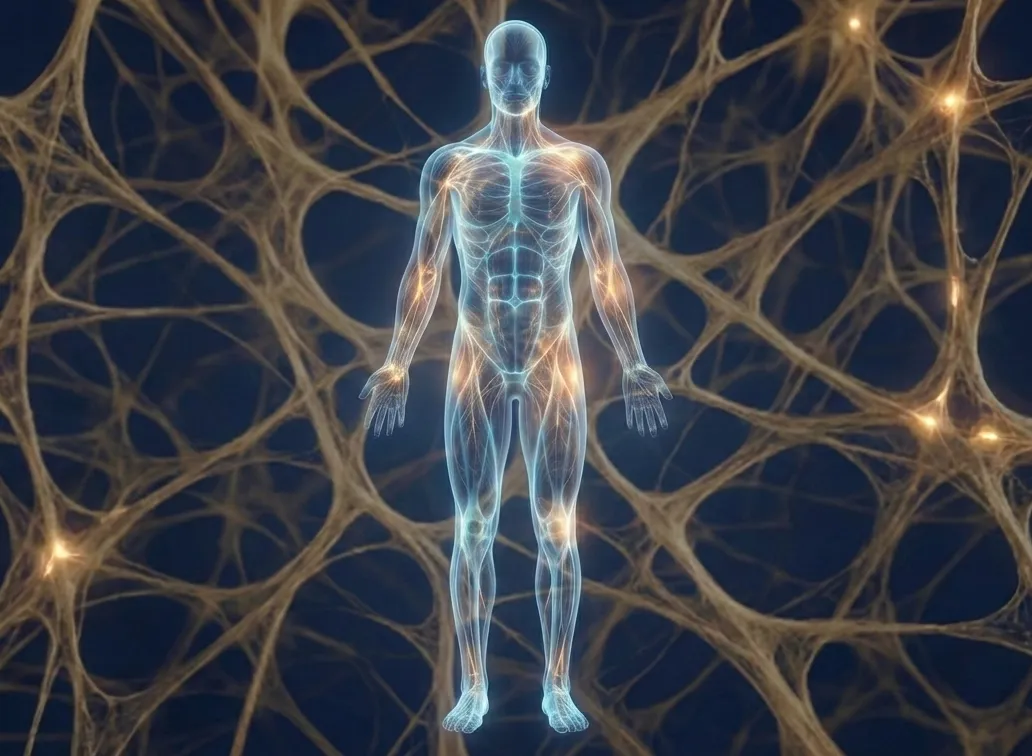
Most of us think of anatomy as muscles and bones, with everything else just acting as “filler.” But fascia is the living, intelligent connective tissue network that weaves through every single part of you.
It is a three-dimensional web that surrounds every muscle, bone, organ, nerve, and blood vessel. Crucially, it is continuous.
- Your foot connects to your hamstring.
- Your jaw connects to your pelvis.
- Your diaphragm connects to your neck.
When you understand this, you realize that the body operates as an integrated whole. Fascia is the network that makes that integration possible. It transfers mechanical force, supports joint stability, and acts as our richest sensory organ.
The Cellular Storage of Trauma
We often hear the phrase “trauma is stored in the body,” but scientifically, what does that actually mean? It can sound abstract, but the reality is grounded in cellular biology.
Cells do not store “memories” like a movie reel. However, chronic emotional or physical stress drastically increases the tone of your sympathetic nervous system (your fight-or-flight response). This elevated tone causes subconscious muscular guarding—a literal bracing against the world.
When this bracing is sustained, your connective tissue physically adapts. Pioneering research by Langevin et al. (2009) demonstrated that fascia actively remodels in response to mechanical stress. The cells within your fascia, called fibroblasts, begin laying down thicker, denser tissue to support this constant state of tension. Protective emotional responses become embodied structural patterns.
A Microscopic Look at Communication Breakdown
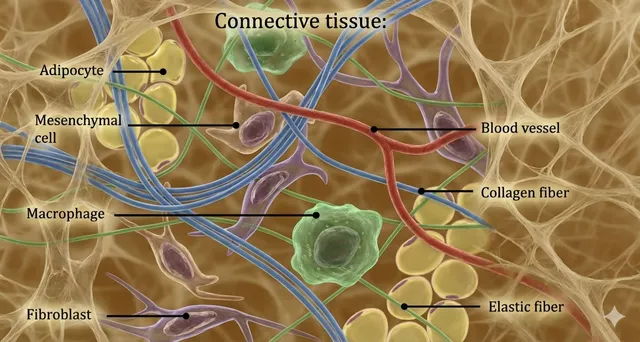
This is an image of our biological superhighway. Take a close look at this microscopic cross-section. You can clearly see how blood vessels, neural inputs, and essential fluid pathways are suspended within the web of collagen and elastic fibers. This system is designed for flow. But when you view this intricate mesh, the reality becomes obvious: if this structure is blocked, stagnant, or compromised by tension, so is everything passing through it. The fluids, nutrients, and bio-electrical energy trying to move through and ‘talk’ to the rest of your body are effectively silenced, turning a biological superhighway into a traffic jam.
Postural Alignment and The Ripple Effect
Because fascia remodels itself based on how you use it, the cycle of chronic pain often looks like this:
- Repetition becomes structure.
- Structure becomes pattern.
- Pattern becomes pain.
This remodeling directly dictates your postural alignment. If you are constantly stressed, your chest fascia may thicken to hold your shoulders in a rounded, protective slump. If your posture collapses, your body has to create compensation chains to keep you upright.
Because this web is continuous, treating the site of the pain often misses the root cause. Those guarded hips might be the real reason for your jaw clenching. That restricted diaphragm could be the hidden anchor pulling on your neck. If strengthening exercises haven’t fixed your posture, it is likely because the underlying fascial web needs decompression first.
Autoimmune Regulation: The Missing Link
We are only just beginning to understand how deeply fascia impacts our internal health. Fascia is not just a mechanical wrapper; it is highly innervated and deeply entwined with the immune system.
Research led by Dr. Robert Schleip and the Fascia Research Society (2012) highlights fascia as one of the body’s most sensory-rich tissues. It houses an abundance of mechanoreceptors, but it is also packed with immune cells like macrophages and mast cells. When fascia becomes rigid and restricted from chronic stress, it severely limits fluid exchange and traps inflammation.
This creates a feedback loop: restricted fascia drives systemic inflammation, which can disrupt autoimmune regulation, leaving the body in a constant state of hyper-reactivity. Restoring fascial glide isn’t just about moving better; it is about signaling safety to your immune system.
The Fascia Healing Method™: Safety Over Force
Healing this web isn’t about forcefully breaking up tissue; it’s about creating the conditions for safety and reorganization.
The Fascia Healing Method™ (FHM) moves away from aggressive manipulation. Fascia responds best to slow, sustained decompression. Rapid, heavy pressure triggers the nervous system’s protective response, causing the body to harden further. Slow engagement allows the tissue to melt, creating a profound sense of safety for the nervous system.
When we combine this with Aerial Fascial Release (AFR)—using gravity-assisted suspension—we change the environment entirely.
- Joint compression reduces.
- The spine elongates.
- Trapped fluids exchange, hydrating the tissue.
By removing the constant, heavy load of gravity, deep tension patterns are finally free to unwind safely.
A New Paradigm of Wholeness
Fascia sits at the exact intersection of structure and sensation, posture and emotion, movement and immune regulation. Ignoring it guarantees that we will spend a lifetime chasing symptoms.
If you are tired of temporary fixes, it may be time to look deeper than the muscle. It’s time to work with the connective web that holds you together.
Fascia is not a wellness trend. It is the biological foundation of your humanity. And when we work with it intelligently, the entire system heals.
The Invitation to Mastery
Fascia is not a wellness trend. It is the biological foundation of human movement and emotion. Whether you are a practitioner looking to deepen your toolkit or an individual seeking to understand your own pain, the path forward requires a new lens.
We are currently accepting applications for our upcoming Fascia Healing Method™ & Aerial Fascial Release certification. This is an invitation to move beyond symptom management and into the realm of true structural integration.
Apply Now for EnrolmentSpaces are limited. Secure your place in the next cohort.